

Quick Summary
Handle insurance claim disputes after a disaster by stopping further damage, documenting everything with dated photos and a matching inventory, and putting every request in writing. If the insurer denies or undervalues the claim, ask for the reason in writing, cite the specific policy language, and escalate on a documented schedule.
- Stop further damage, keep emergency receipts, and keep damaged items until an adjuster sees them.
- Keep original photos and videos unedited, and back them up to cloud storage the same day.
- Cross-reference each inventory line item to a specific photo file name.
- Cite the policy section by page number when you dispute a denial or valuation.
- Do not deposit a settlement check you disagree with until you confirm in writing that negotiation remains open.
Table of Contents
- Take Immediate Steps After the Damage Happens
- Document Damage With Photos, Video, and an Inventory
- Understand Your Policy Coverage and Why Claims Get Denied
- Communicate With Your Adjuster and Keep a Dispute Log
- Write a Sample Insurance Claim Dispute Letter
- Decide When to Bring In a Public Adjuster
- Start Your Next Steps: Restoration and Repairs With B&G Home Improvement
- Frequently Asked Questions
Last Updated: October 29, 2026
Insurance claims after a disaster rarely go smoothly. A house with water or fire damage can lose thousands of dollars in value in a single afternoon, and the claim process can drag on for months. When an insurer offers less than the repair will cost, or denies the claim outright, homeowners need a clear plan. A well-documented claim can make the difference between a fair settlement and a long fight.
Take Immediate Steps After the Damage Happens
The first hours after a disaster matter most for your claim. Read the step-by-step emergency water damage restoration process to see what happens next.
Start with safety. Shut off power and water if there is any risk, and leave the building if the structure looks unsafe.
Next, stop the damage from getting worse.
Do not throw anything away yet. Damaged items are evidence. Set them aside until an adjuster has seen them.
Call your insurance company as soon as you can. Write down the date, time, the representative's name, and a claim number.
Document Damage With Photos, Video, and an Inventory
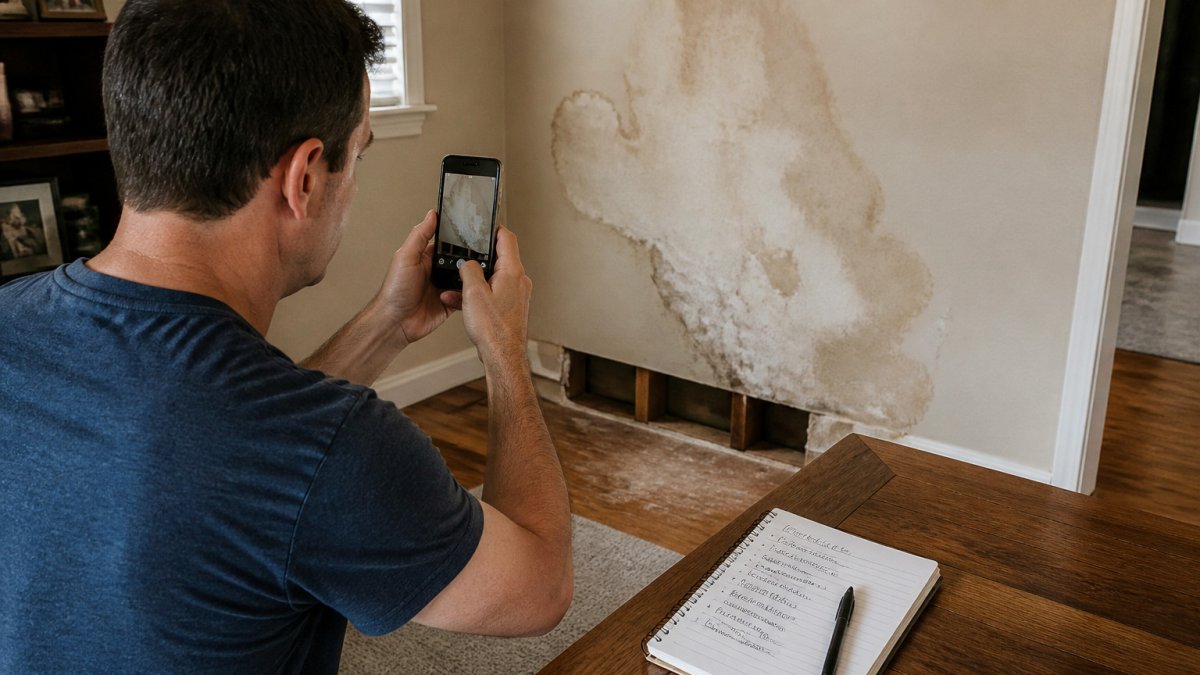
Good documentation wins disputes. For the detailed method, see how to document water damage for insurance claims. Insurers pay based on what you can prove, so record everything before cleanup begins, and record it in a way an adjuster can actually use. A phone full of unsorted photos is not evidence; a dated, labeled, backed-up file set is.
Capture the right shots in the right order
Work room by room and shoot in this sequence so nothing is missed:
- Wide establishing shots of each room from all four corners, taken at chest height
- Mid-range shots of each damaged area (ceiling stain, buckled floor, charred cabinet)
- Close-ups with a ruler or coin in frame to show scale
Then film a slow video walkthrough, narrating out loud: room name, what you see, and the date. A narrated video is harder for an adjuster to dispute than a silent clip because your commentary establishes context and timing.
Preserve metadata, it is your proof of when
Every photo and video carries EXIF metadata: the date, time, and often GPS coordinates of capture. That metadata is what proves the damage existed on the date of loss and not after. Two rules protect it:
- Do not edit, crop, or filter original files. Editing strips or alters metadata and gives an insurer grounds to question authenticity. Keep originals untouched and make edited copies only for your own reference.
- Do not rely on a single device. Phones get dropped, soaked, or stolen during disasters. Upload originals to cloud storage the same day, and keep a second copy on a physical drive stored off-site.
Use a file-naming convention adjusters can follow
Adjusters handle hundreds of claims. Files named IMG_4471.jpg get skimmed; files named by room, item, and date get read. Adopt a simple convention and apply it to every upload:
[Room]_[Item or Area]_[YYYY-MM-DD]_[Sequence]
For example: Kitchen_FloorWaterDamage_2026-10-29_01.jpg or Basement_HVACSerial_2026-10-29_03.jpg. Group files into folders by room, and include a one-page index at the top of the folder listing what each folder contains. This is the single cheapest step that separates a professional-looking claim from an amateur one.
Build a written inventory that matches your photos
A spreadsheet inventory should include, for every damaged item:
- Item description and quantity
- Room and location
- Brand, model, and serial number where available
Tie each inventory row to a specific photo file name. When an adjuster questions a line item, you can point to the exact image that supports it. This cross-reference is what most homeowners skip, and it is what makes an inventory persuasive rather than a wish list.
Separate sudden damage from gradual damage in your records
Many policies cover sudden and accidental events but exclude slow leaks, repeated seepage, and long-term deterioration. Your records should make the timeline obvious: note the date you first observed the damage, the date of the triggering event if there was one, and any prior repair or inspection records. If a plumber or roofer inspected the area before the loss, get that report and keep it with your file.
Understand Your Policy Coverage and Why Claims Get Denied
Your policy decides what gets paid. Check whether fire smoke damage is covered in fire smoke damage coverage under your policy. Read the declarations page, the coverage limits, and the exclusions before you argue with an adjuster.
Two valuation terms come up often. Actual cash value subtracts depreciation from the cost of a new item. Replacement cost pays what it costs to buy new, though many policies pay the actual cash value first and the rest after you complete repairs.
Claims get denied for a few common reasons:
- The damage was gradual, not sudden
- The loss falls under an exclusion, such as flood or long-term leaks
- The homeowner did not mitigate further damage
If your claim is denied, ask for the denial in writing and the specific policy language used. A written reason gives you something concrete to challenge.
Communicate With Your Adjuster and Keep a Dispute Log
Most guides tell you to "keep records" of adjuster conversations and stop there. That advice fails at the moment it matters, when a claim is denied or undervalued and you need to show exactly what was said, when, and by whom. This section gives you the structure competitors skip: a communication log with defined fields, a policy-citation habit, and a paper trail that survives escalation.
Put everything in writing, and convert calls into writing
Email is your default channel. When you must talk by phone, send a follow-up email within 24 hours that summarizes the call in plain terms:
Call the Expert Renovation Contractors Now →
"This email confirms our call today at 10:15 a.m. with [representative name]. You stated that the settlement offer for claim [number] is $[amount] and that the missing line item for [item] was excluded because [reason given]. I requested [specific request]. Please reply if this summary is inaccurate."
That single habit creates a written record even when the insurer prefers phone calls. If the adjuster does not correct your summary, the record stands.
Build a dispute log with defined fields
A dispute log is a simple spreadsheet with one row per interaction. At minimum, capture:
- Date and time of contact
- Channel (phone, email, portal message, in-person inspection)
- Name and title of the person you spoke with, plus any reference or extension number
A log does two things a memory cannot: it shows patterns (three unanswered requests, two missed deadlines) and it produces a clean chronology you can attach to a formal complaint or appeal.
Cite the policy language, not just the dollar figure
When you disagree with a denial or a valuation, quote the specific policy section. Pull the declarations page, the coverage form, and the exclusions, and reference them by page and section number in your emails and letters.
This is the habit that separates a persuasive dispute from a complaint. Adjusters respond to policy citations because they must justify their file internally against the same language.
Track deadlines and escalate on a schedule
Most policies require prompt notice and cooperation, and many states impose claim-handling deadlines on insurers, commonly requiring acknowledgment within a set number of days and a decision within a defined period after proof of loss is submitted. Deadlines vary by state and policy, so confirm yours in writing. Then build an escalation ladder into your log:
- Written follow-up to the adjuster with a response deadline
- Written request to the adjuster's supervisor
- Formal complaint to your state insurance department (keep the complaint number in your log)
- Review of your policy's appraisal or arbitration clause, if it has one
Each rung should reference the prior rung and the dates. A log that shows you escalated on a documented schedule is far stronger than a series of angry calls.
The dispute log fields below capture what each interaction should record, so you can show exactly what was said and when.
| Log field | What to record | Why it matters |
|---|---|---|
| Date and time | Exact time of each contact | Builds a clean chronology |
| Channel | Phone, email, portal, or in-person | Shows which contacts were written |
| Name and title | Representative's name, title, and reference number | Identifies who made each statement |
| What was said | Factual summary, not opinion | Creates a neutral record |
| What you requested | Your request and the response given | Shows whether requests were answered |
| Deadline or follow-up | Promised date, if any | Tracks overdue responses |
| Status | Open, answered, or overdue | Shows patterns of delay |
| Linked documents | File names of emails, letters, or photos | Connects each entry to its evidence |
Write a Sample Insurance Claim Dispute Letter
A clear letter often moves a claim forward faster than a phone call. Here is a sample you can adapt:
Dear [Adjuster Name],
I am writing about claim number [Claim Number] for damage to my home at [Address], which occurred on [Date of Loss]. On [Date], I received your settlement offer of [Amount]. I disagree with this amount for the following reasons: [specific reason, such as a missing item or an incorrect depreciation figure].
Enclosed are the photos, video, inventory, and repair estimate supporting my position. I request a written explanation of how the amount was calculated and a review of the items listed. Please respond within 30 days.
Sincerely, [Your Name] [Phone] | [Email]
Send the letter by certified mail or with a delivery receipt, and keep a copy.
Decide When to Bring In a Public Adjuster
A public adjuster works for you, not the insurer.
Consider hiring one when the damage is large, the offer is far below your repair estimate, or the claim has stalled. Review emergency disaster restoration quotes and costs before deciding.
Check the adjuster's license with your state insurance department before you sign. Read the contract closely, including how long it lasts and how the fee is calculated.
Start Your Next Steps: Restoration and Repairs With B&G Home Improvement
Once the claim is moving, the next step is repairs. B&G Home Improvement Inc. is a locally owned and staffed remodeling contractor that provides disaster restoration services in the Triangle area. Call us for a consultation to discuss your project.
Frequently Asked Questions
Who pays for water leak damage?
Whether your insurer pays for water leak damage depends on the cause and your policy. Standard homeowners policies typically cover sudden and accidental discharge, such as a burst pipe, but often exclude gradual leaks, long-term seepage, and flood damage, which usually requires a separate National Flood Insurance Program or private flood policy. Read the water damage section of your declarations page and exclusions carefully. If the insurer denies the claim, ask for the specific policy language it relied on in writing, then compare that language against the facts documented in your photos, plumber report, and timeline.
What are the common reasons for insurance claim denials after a disaster?
Common reasons include a late notice of loss, damage the insurer classifies as excluded such as gradual deterioration or wear, failure to take reasonable steps to prevent further damage, missing documentation, and disputes over the scope or cost of repairs. Many denials are partial, meaning part of the claim is paid while other items are rejected. Respond in writing, cite the policy provision you believe applies, and attach supporting evidence such as photos, receipts, and contractor estimates.
When should I hire a public adjuster for a disaster claim?
Consider a licensed public adjuster when the damage is extensive, the settlement offer is far below your documented losses, the insurer disputes the cause of loss, or the claim involves complex coverage questions. Public adjusters work for you rather than the insurer and typically charge a percentage of the settlement, often commonly ranging from 5 to 20 percent depending on the state and the complexity of the claim. Verify the adjuster's license with your state department of insurance before signing any contract, and review the fee terms closely.
Can I hire an independent contractor to verify damage estimates?
Yes. Getting a written, itemized estimate from a licensed local contractor gives you an independent basis for comparing the insurer's scope of work. Ask the contractor to note the cause of damage, the materials affected, and the repair method so the estimate is easy to compare line by line. Share the estimate with your adjuster in writing and request a reinspection if the figures differ significantly. Keep all estimates and correspondence in your dispute file.
