
Table of Contents
- How to Judge Kitchen Flooring Durability
- Durability Scorecard: Best Kitchen Flooring Materials Compared
- Porcelain Tile vs Luxury Vinyl Plank: Which Wins in a Kitchen?
- Laminate vs LVP Flooring: The Honest Kitchen Comparison
- Best Waterproof Flooring for Kitchens: What Actually Survives Spills
- Kitchen Flooring Pros and Cons: What Homeowners Regret
- Repairability, Installation Risks, and Long-Term Costs
- Frequently Asked Questions
Last Updated: October 5, 2026
How to Judge Kitchen Flooring Durability
Choosing the best kitchen flooring materials for durability starts with what destroys a floor: standing water after a spill, a dropped cast-iron pan landing edge-first, a chair scraping the same square metre weekly, and a hot baking tray falling off the counter.
Most failed kitchen floors did not fail because the homeowner picked a bad material, but because it was matched to the wrong kitchen. A floor that survives a retired couple will fall apart under three kids and a Labrador.
The Five Tests Every Kitchen Floor Faces
Water resistance eliminates the most options.
Wear resistance covers foot traffic and grit.
Scratch and stain resistance matters because kitchen floors collect red wine, turmeric, pet claws, and dragged appliances.
Impact resistance is about dropped objects. Ceramic tile can chip or crack under a heavy pot.
Heat resistance is the one most buyers forget. A 400-degree sheet pan landing on vinyl leaves a permanent mark.
Durability Scorecard: Best Kitchen Flooring Materials Compared
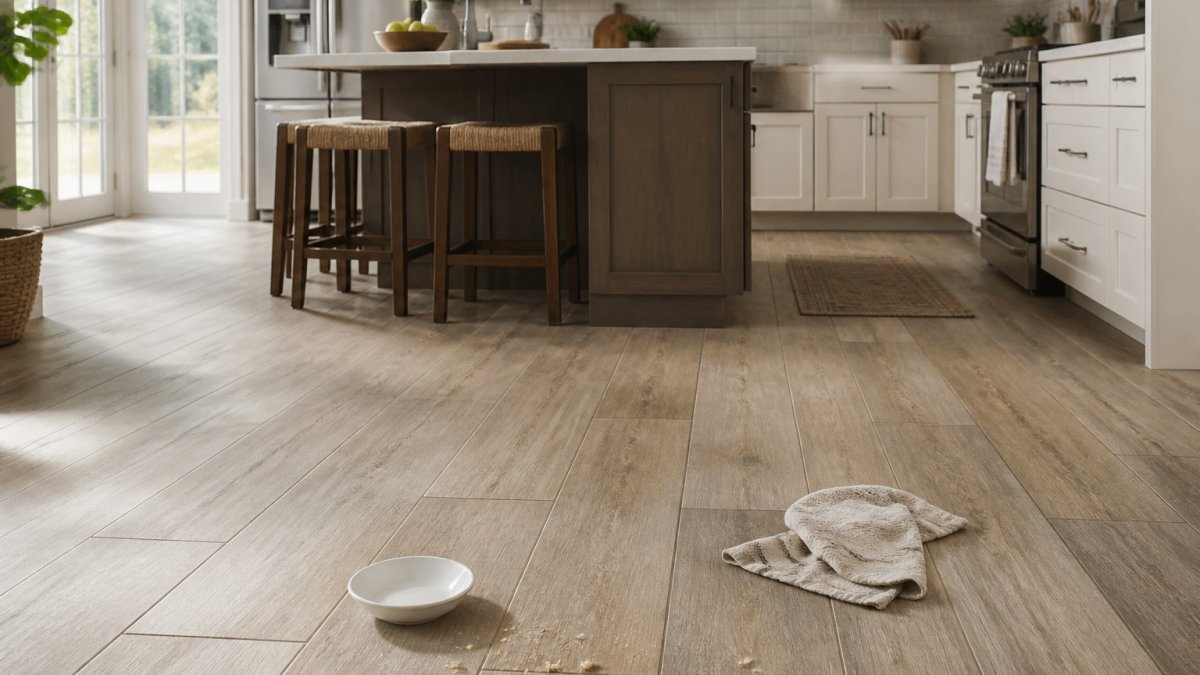
Here is how the main options score on the same five criteria. Ratings are relative to each other, not absolute.
| Material | Water Resistance | Wear & Scratch | Impact | Heat | Best For |
|---|---|---|---|---|---|
| Porcelain tile | Excellent | Excellent | Fair | Excellent | Busy families, wet zones |
| Luxury vinyl plank | Excellent | Good | Very good | Poor | Budget-conscious, DIY-friendly |
| Sheet vinyl | Excellent | Fair | Very good | Poor | Rental units, quick installs |
| Laminate | Poor | Good | Fair | Fair | Dry kitchens, low spill risk |
| Engineered hardwood | Fair | Fair | Good | Fair | Open-plan homes, low moisture |
| Solid hardwood | Poor | Fair | Good | Fair | Formal kitchens, careful owners |
| Cork | Poor | Poor | Very good | Fair | Comfort-first, adults only |
| Linoleum | Fair | Fair | Good | Good | Eco-minded, moderate traffic |
Scorecard Results by Material
Porcelain tile is the durability champion. Fired at high temperature, it resists water, heat, and scratching better than anything else here.
Luxury vinyl plank is the best all-rounder for most kitchens. It is fully waterproof, comfortable underfoot, and handles dropped items without cracking. Heat is its weakness.
Laminate looks like wood and resists scratches, but its core is wood-based. Standing water seeps into the seams and swells the planks, a real risk near a dishwasher or ice maker.
Porcelain Tile vs Luxury Vinyl Plank: Which Wins in a Kitchen?
Porcelain tile wins on water, heat, and scratch resistance. Luxury vinyl plank wins on comfort, cost, and installation speed. The right pick depends on your household, not on which material is objectively better.
If you have young children, pets, or a habit of dropping things, LVP absorbs the abuse. If you want a floor that outlasts the mortgage and do not mind a harder surface, porcelain is the answer.
- Comfort: Tile is cold and hard. Standing at the counter for an hour is noticeably tougher on your back and knees.
- Repair: A cracked tile can be replaced individually if you kept spares. A gouged LVP plank can also be swapped, but only if the locking system allows it.
- Cleaning: Tile with sealed grout is easy to mop. LVP is easier still, with no grout to scrub.
Laminate vs LVP Flooring: The Honest Kitchen Comparison
LVP is the better kitchen choice in almost every case: laminate has a wood-fiber core that water destroys, while LVP is plastic through and through.
That difference drives everything else. Laminate feels warmer, often looks more like real wood, and resists scratches slightly better than entry-level LVP. But in a room with a sink, dishwasher, and refrigerator ice line, water exposure is a certainty, not a possibility.
Best Waterproof Flooring for Kitchens: What Actually Survives Spills
The genuinely waterproof options are porcelain tile, luxury vinyl plank, sheet vinyl, and linoleum.
Call the Expert Renovation Contractors Now →
But "waterproof" is not one property.
1. Does the material itself absorb water? Porcelain tile, sheet vinyl, LVP, and linoleum are non-absorbent.
2. Do the seams let water through? This is where most "waterproof" floors fail.
3. What happens underneath? A waterproof surface over a wood subfloor still fails if water reaches the wood.
How Each Waterproof Option Fails
- Porcelain tile: Fails at the grout, not the tile. Unsealed grout stains and wicks water; a cracked tile lets water into the substrate. With sealed grout and a crack-isolation membrane, it is the most forgiving of repeated wetting.
- Luxury vinyl plank: Fails at the seams and perimeter. Standing water against a wall or in a seam for hours can wick into the core of lower-grade planks. Rigid-core (SPC) planks tolerate far more than flexible glue-down or thin click products.
- Sheet vinyl: Fails at the edges and under heavy appliances. A lifted edge lets water run underneath, and the damage is invisible until the floor feels soft. It is the most water-tolerant surface per dollar, but the least repairable.
The Water-Exposure Reality of a Kitchen
A kitchen does not experience one big flood but hundreds of small ones: the ice maker line that drips weekly, the dishwasher door that leaks a cup per cycle, the dropped glass, the mop bucket. The materials that survive tolerate repeated small wetting and dry out completely between events; the ones that fail hold moisture against a wood core or subfloor.
For a kitchen with known leak risk, sheet vinyl or porcelain tile with sealed grout over a properly prepped substrate is the safest bet. For the best balance of water tolerance, comfort, and repairability, a rigid-core SPC luxury vinyl plank with sealed seams is the practical answer for most households.
Kitchen Flooring Pros and Cons: What Homeowners Regret
Most flooring regret comes down to three things: choosing looks over water resistance, skipping subfloor preparation, or underestimating how hard tile feels after a long day.
- "I wish we had gone waterproof." The number one regret. Homeowners pick laminate or hardwood for the look, then watch a small leak ruin it.
- "The tile is too hard on my feet." Real, and worth planning for with a mat at the sink and stove.
- "The floor is not level and now the planks creak." This is an installation problem, not a material problem.
- "We did not buy spares." Dye lots change. Without extra boxes from the same run, a future repair will not match.
Homeowners who match the material to their actual household almost never regret it. Durability is not about the best material, it is about the right one.
Repairability, Installation Risks, and Long-Term Costs
Repairability separates materials more than any spec sheet and is the most overlooked factor in lifetime cost. A floor you can patch in an afternoon is worth more than one that looks better but needs a full tear-out after one accident.
How Repairable Is Each Material?
- Porcelain and ceramic tile: The most repairable surface if you kept matching spares. A single cracked tile can be chiseled out and replaced without touching the rest of the floor. Without spares from the same dye lot, a repair will not match. Grout can be regrouted and resealed independently.
- Luxury vinyl plank: Repairable in theory, variable in practice. A plank at the edge of a run can often be lifted and swapped; one in the middle usually requires disassembling the run back to the damaged piece, so some installers cut out the plank and glue in a replacement. That repair is functional but visible under raking light.
- Sheet vinyl: The least repairable. A damaged section is patched, and the seam rarely disappears, in a high-traffic kitchen, a permanent reminder.
- Laminate: Repairable only if the damaged planks sit at the edge of a run and the locking system allows disassembly. Water damage usually affects a cluster, not one plank, so the repair is larger than it looks.
Installation Risks That Decide Real-World Durability
Installation quality decides how long any floor lasts. Common failure points include:
- Subfloor flatness. Most plank and tile products need a flat, stable subfloor within a small tolerance over a short span. Skip it and you get hollow spots, cracked tile, and clicking seams, the number one cause of callbacks.
- Moisture barriers. Over a concrete slab, a missing vapor barrier traps moisture and ruins the floor from below. Over wood, a moisture-tolerant underlayment protects the subfloor from small leaks.
- Expansion gaps. Rigid materials need room to move. Pinch them against a wall and the floor buckles in summer, a seasonal failure that often appears months after installation.
- Grout and sealing. Unsealed grout stains and wicks water. Sealed grout lasts. Resealing is a recurring cost, not a one-time task.
Lifecycle Cost: The Number Most Homeowners Never Calculate
Lifecycle cost is the number most homeowners never calculate. A cheaper floor that needs replacing in five years costs more than a pricier one that lasts twenty. Divide installed cost by years of service and porcelain and quality LVP usually win.
- Porcelain tile: Highest upfront cost, lowest recurring cost. Cleaning is simple, grout resealing is periodic, and repairs are cheap if spares are kept. It rarely needs replacement within a normal ownership window.
- Luxury vinyl plank: Moderate upfront cost, low recurring cost. No sealing, no refinishing, easy cleaning. Replacement is the main risk, usually triggered by water damage at a seam or a heat scar rather than wear.
- Sheet vinyl: Lowest upfront cost, highest replacement frequency, the right choice when the goal is a short service life, such as a rental turnover.
- Laminate: Low upfront cost, high risk of early replacement in a kitchen. The purchase price is attractive; the water risk is not.
The pattern is consistent: the lowest purchase prices tend to carry the highest lifetime cost in a kitchen, because the kitchen is the room most likely to trigger an early replacement.
Frequently Asked Questions
What is the most durable flooring for a kitchen?
Porcelain tile typically outlasts every other kitchen flooring material, often lasting 50 years or more with proper installation. Its density resists scratches, stains, and moisture far better than vinyl, laminate, or wood. That said, durability only matters if the floor suits your household and installation conditions. A well-installed luxury vinyl plank can outperform a poorly installed tile floor, so prep and workmanship matter as much as the material itself.
Which lasts longer, laminate or LVP?
Luxury vinyl plank generally lasts longer in a kitchen because its core is waterproof, while laminate's fiberboard core swells when moisture seeps into seams. A quality LVP floor can last 15 to 25 years in a busy kitchen, whereas laminate may need replacement in 10 to 15 years if spills are not wiped up promptly. Laminate offers a harder surface and better scratch resistance in dry areas, but the kitchen's moisture exposure gives LVP the edge for lifespan.
Is porcelain tile or luxury vinyl more durable for a kitchen?
Porcelain tile wins on hardness, scratch resistance, and lifespan. It will not dent, fade, or swell from water, and it holds up to dropped pots and heavy foot traffic for decades. Luxury vinyl plank offers better comfort underfoot and is easier to install, but its wear layer can scratch or dull over time. For pure durability, porcelain is the stronger choice. For warmth and a softer feel, LVP is the practical alternative.
What kitchen flooring holds up best to spills and heavy foot traffic?
Waterproof options handle spills best: porcelain tile, luxury vinyl plank, and sheet vinyl all resist moisture at the surface. For heavy foot traffic, porcelain tile and LVP with a thick wear layer (20 mil or higher) hold up longest. The key is not just the material but the installation: tight seams, proper subfloor prep, and sealed grout lines prevent water from reaching the layers below and causing the failures homeowners most often regret.
Comments